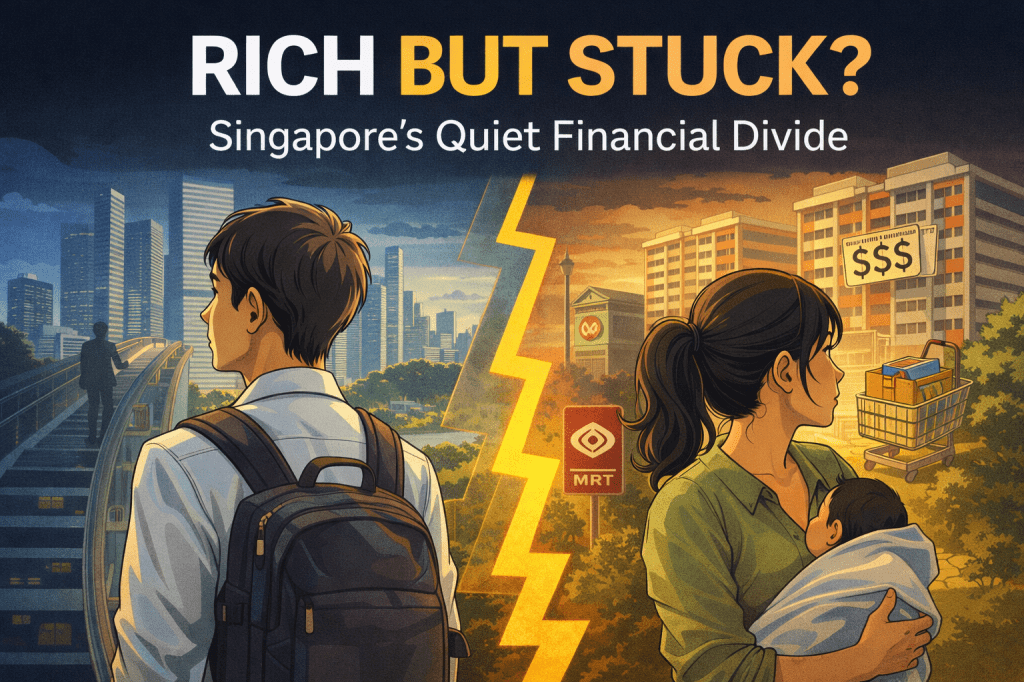
Walk around any MRT station during peak hour and you’ll see it.
Nice clothes.
Latest iPhones.
Crowded cafés.
Fully booked flights.
By global standards, Singaporeans are rich.
Yet quietly, many people feel financially stuck.
Not poor.
Not desperate.
Just… trapped in place.
And 2026 is going to expose this feeling in a very uncomfortable way.
The Singapore Paradox: High Income, Low Freedom
Singapore has one of the highest median household incomes in the world.
But it also has one of the highest costs of staying “normal.”
A typical professional path looks like this:
- Study hard → university → stable job
- Save aggressively → BTO / resale flat
- Pay mortgage → car (maybe) → kids (definitely)
- Repeat for 25–30 years
On paper, this is success.
In reality, many people reach their mid-30s and realise:
“I earn more than my parents ever did…
but I don’t feel more free than them.”
That’s the trap.
Lifestyle Inflation Is Quietly Winning
Singapore doesn’t punish recklessness.
It punishes comfort.
You don’t overspend in dramatic ways – you bleed slowly:
- $7 coffee becomes daily
- Grab instead of MRT “just this once”
- Overseas trips as emotional compensation
- Subscriptions you barely notice
- Insurance stacked on insurance “just in case”
None of these feel irresponsible.
But together, they lock your future in place.
Your income goes up – but so does the minimum amount you need just to breathe.
Why 2026 Will Be a Wake-Up Year
Here’s the uncomfortable truth:
2026 won’t be about who earns more.
It will be about who has optionality.
- AI will compress white-collar roles
- Job mobility will feel higher – but security lower
- Asset prices won’t rise evenly anymore
- “Safe paths” will still work… just slower
The people who struggle won’t be the poor.
They’ll be the ones with:
- high fixed commitments
- zero flexibility
- no exposure beyond salary
That’s when “rich but stuck” becomes painful.
The Quiet Divide Forming in Singapore
A gap is forming – not between rich and poor – but between:
Those with leverage
vs
Those with obligations
Leverage looks like:
- skills that compound (tech, finance, media, systems)
- assets that don’t need daily labour
- cash buffers that buy time
- optional income streams (even small ones)
Obligations look like:
- maxed-out monthly commitments
- lifestyle that depends on steady income
- fear of risk because failure is expensive
- “I can’t afford to try” mindset
Same salary.
Completely different futures.
This Is Not About Quitting Your Job
Let’s be clear – this isn’t a motivational “escape the rat race” rant.
Singapore rewards structure.
Stability still matters.
But 2026 will reward people who quietly prepared options while appearing normal.
That might mean:
- building skills outside your JD
- investing earlier than feels comfortable
- keeping expenses intentionally below your means
- saying no to upgrades you can afford but don’t need
Boring on the surface.
Powerful underneath.
A Question Worth Asking Now
Instead of asking:
“How do I earn more?”
Ask:
“If something breaks in 2026 — how much room do I have to move?”
That answer will matter more than your salary.
Final Thought
Singaporeans are disciplined.
Capable.
Resilient.
But discipline without flexibility becomes a cage.
2026 won’t punish those who are behind.
It will expose those who never built an exit hatch.
If this article made you uncomfortable — that’s a good sign.
It means you’re early.



 The Merlion Baller
Leave a comment